EN
EN  DE
DE  FR
FR  RU
RU  AR
AR  ES
ES  JA
JA 
Choosing between a spout pouch and a bottle for a liquid product SKU is a strategic decision that touches product protection, consumer experience, logistics, and sustainability.
In this guide, GQ PACK, a custom flexible food packaging manufacturer, compares both formats across the decision drivers brands care about, and gives a clear framework for picking the right liquid packaging solution.
Structural Differences Between Spout Pouch and Bottle
A spout pouch is a laminated flexible pouch with an integrated spout and cap; it collapses as product is dispensed. Bottles are rigid, molded containers (PET, HDPE, glass) with a threaded neck and cap.
- Dispensing: pouches allow squeeze-dispense control and reduce post-use headspace; bottles rely on gravity or squeeze action and retain their full volume.
- Fitment: spouts are often single-piece fitments welded into the web, so spout weld integrity is a primary engineering concern for spout pouch formats. Bottle closures depend on neck finish and cap torque control.
Choose a spout pouch when controlled, on-the-go dispensing and reduced post-use volume matter; choose a bottle when rigid protection, easy pouring, or existing cap-and-dispense equipment are critical.
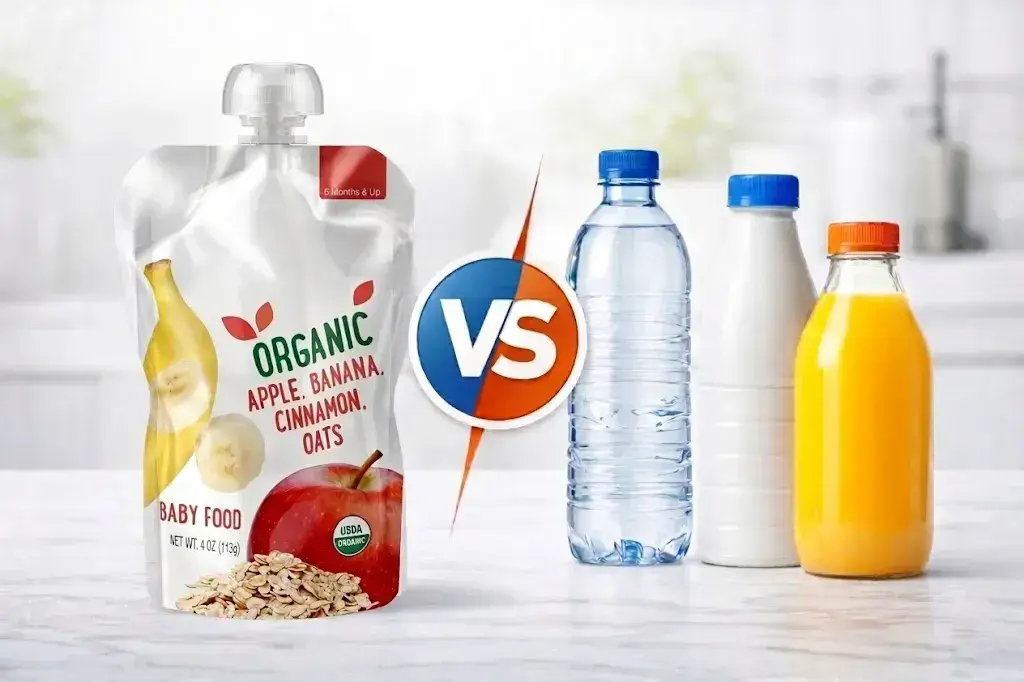
Cost Comparison: Material, Production, and Scale
Flexible spout pouch formats typically consume less material by weight than bottles, and empty pouches ship flat—reducing inbound logistics cost. However:
- Production costs for spout pouch include multi-layer film, lamination, spout fitments, and high-precision pouch forming/welding. Custom printing and special finishes can raise unit cost.
- Bottles involve tooling and molding costs (higher upfront), but high-volume blow-molding often yields lower per-unit costs at scale.
For short to mid production runs or when freight cost is a priority, spout pouch often delivers a lower total landed cost. For very large run sizes or where packaging reusability is valued, bottles can be more economical.
| Factor | Spout Pouch | Rigid Bottle |
| Logistics | Superior. Ships flat; minimal inbound cost. | Poor. High volume; paying to ship “air.” |
| Material | Lightweight; multi-layer film + fitments. | Heavyweight; resin-intensive. |
| Upfront Cost | Low. No custom molds required. | High. Significant tooling/mold capital expenditure. |
| Unit Cost | Efficient for short/mid runs. | Lowest at mass scale (blow-molding). |
| Efficiency | Slower filling/sealing speeds. | Lowest at the mass scale (blow-molding). |
Logistics, Storage, and Shelf Impact
Flexible spout pouch options win on space efficiency: empty pouches collapse for compact transport and palletization. During distribution, pouches pack tightly, lowering freight and storage costs.
Bottles require more volume and heavier pallets, increasing transportation emissions for the same product mass.
On shelf, bottles provide a stable silhouette and perceived premium feel; spout pouch shelf placement (stand-up or hanging) offers visibility and allows brands to maximize shelf and planogram efficiency.
Liquid Protection and Shelf Life Considerations
Barrier performance is a core functional requirement for liquid packaging.
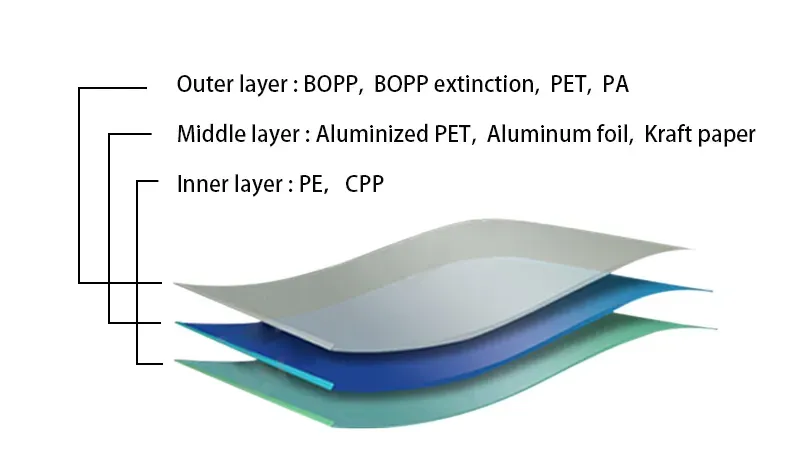
- Spout pouch multi-layer laminates (PET/AL/PE, PET/NY/PE, or EVOH-encapsulated PE) can meet high MVTR/OTR targets, but structure selection must be validated for the product matrix (fats, acids, light sensitivity).
- Bottles (especially glass and certain engineered PET) provide superior oxygen and light barriers without complex laminates.
If your liquid is oxidation- or light-sensitive, perform MVTR/OTR testing and accelerated shelf-life validation for spout pouch constructions before committing. For products requiring long ambient shelf life or high-temperature resistance, bottles are often the safer choice.
Consumer Convenience and Usability
Spout pouch formats excel at portability, single-serve convenience, and low post-use space. They are ideal for baby food purees, travel beverages, and sports nutrition liquids. Resealable spouts preserve freshness between uses.
Bottles are preferable when consumers expect multiple pours, stable storage in refrigerators, or a premium tactile experience. For carbonated or pressurized liquids, bottles remain the standard.
Sustainability Trade-offs and End-of-life Realities
Flexible spout pouch formats reduce material use and transport emissions, but recyclability has ground realities:
- Mono-material spout pouch constructions (PE-based or PP-based) can be compatible with existing recycling streams where local collection exists. However, integrated spouts, multi-material fitments, and adhesives can negate recyclability unless designed as a full-system solution.
- Bottles benefit from established bottle-to-bottle recycling streams, especially PET and HDPE, and collection rates are often higher.
If sustainability is a top priority, specify mono-polymer pouches, compatible spouts, or clear disassembly instructions. Validate with local recycling partners before marketing claims.
Filling Technology and Line Integration
Filling methods differ by format and viscosity:
- Spout pouch filling is done on pre-made pouch fillers or form-fill-seal machines (gravity, piston, or pump filling). High-speed spout welding and cap placement require precise synchronization. Pilot trials on the intended filler are mandatory.
- Bottles use rotary or inline fillers with capping and labeling integrated; machinery is mature and often simpler to validate.
When switching to a spout pouch, budget for line trials, spout-weld validation, and potential filler modifications.
Risk Matrix and Decision Framework
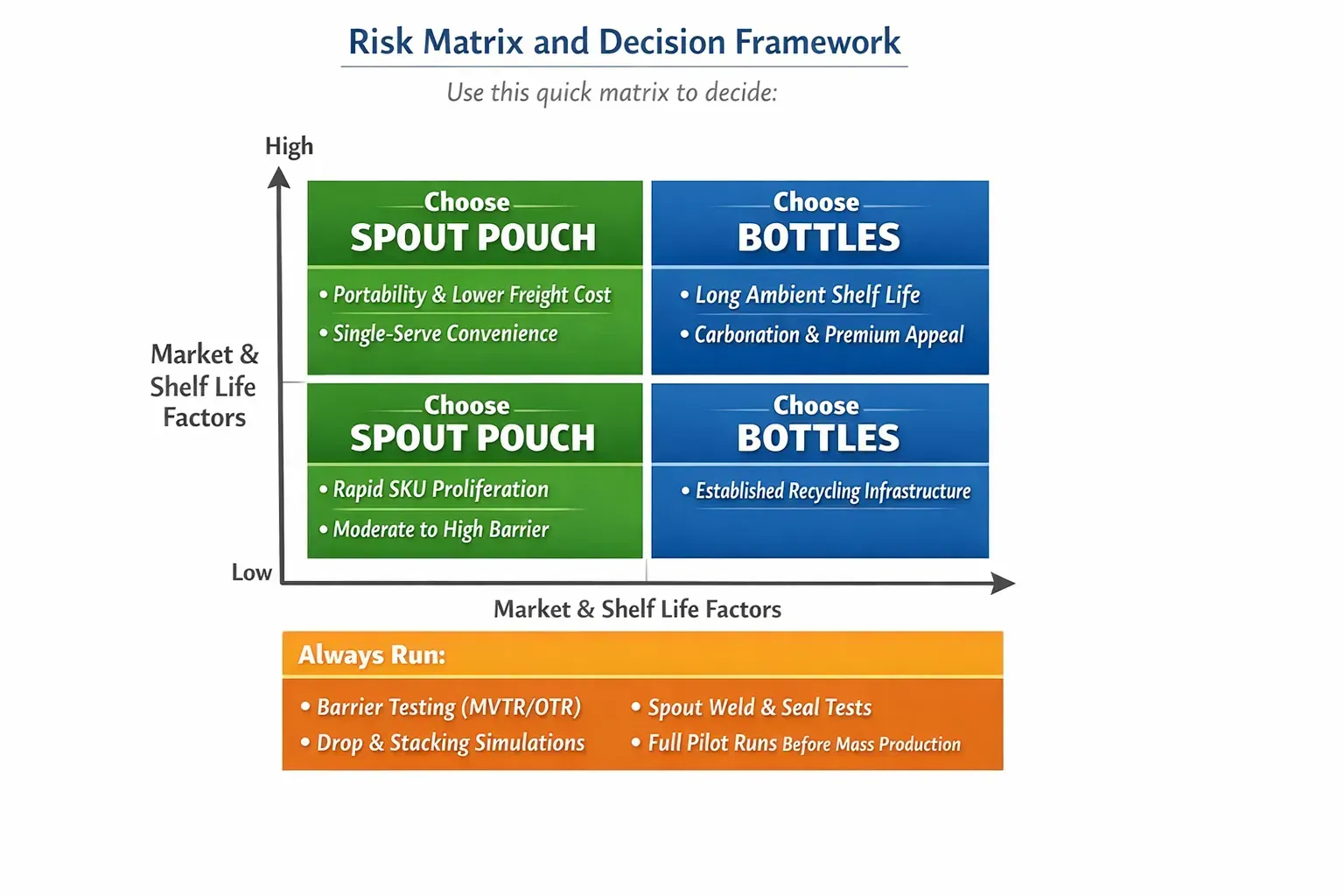
Use this quick matrix to decide:
- Choose a spout pouch if: portability, lower freight cost, single-serve convenience, or rapid SKU proliferation matter; product barrier need is moderate to high and validated; and recyclability can be addressed.
- Choose bottles if: long ambient shelf, carbonation, premium tactile presence, or established recycling infrastructure are decisive.
Always run: barrier testing (MVTR/OTR), spout weld and seal strength tests, drop and stacking simulations, and full pilot runs before mass production.
Practical Steps For Liquid Food Brands
- Define product requirements: viscosity, fat content, target shelf life, and distribution climate.
- Request technical data from suppliers: MVTR/OTR, seal strength (N/15mm), spout weld strength, and pilot run yield.
- Validate recyclability claims with local processors if sustainability is marketed.
- Pilot on your filler and measure: fill accuracy, leak rates, spout torque, and consumer opening tests.
- Model TCO including freight, scrap, and potential EPR fees.
Conclusion
Both spout pouches and bottles remain valid options in modern liquid packaging. The choice is not inherently “better” or “worse”; it is about aligning product chemistry, consumer behavior, logistics, economics, and sustainability goals. Treat the decision as an engineering and supply-chain optimization: test, validate, and quantify. That is how brands choose a packaging format that protects product, lowers cost, and supports long-term market success.
About GQ PACK
GQ PACK is a custom flexible food packaging manufacturer specializing in liquid spout pouch packaging solutions for B2B brands. Our factory controls critical production stages—from multi-layer film lamination and precision printing to pouch forming, spout welding, and sealing—ensuring stable quality across large and repeat production batches.
With deep expertise in spout pouch engineering, we help clients balance product protection, logistics efficiency, and consumer usability. GQ PACK also provides custom spout pouch solutions, including material structure selection, spout configuration, and custom printing, enabling food and beverage companies to develop reliable, market-ready liquid packaging at scale.