FR
 EN
 DE
 RU
 AR
 ES
 JA

Individually sealed jelly cups do not always require an additional outer bag. An outer packaging pouch for jelly cups becomes valuable when multiple cups need to form a single retail unit, provide additional branding space, or remain grouped during handling and distribution.
However, adding another packaging layer also increases material consumption and introduces additional packing operations. Jelly manufacturers should therefore determine whether the outer pouch performs a necessary function or delivers sufficient commercial value before incorporating it into their packaging system.
What Does an Outer Packaging Pouch Do for Jelly Cups?
Jelly cup packaging can involve three packaging levels, each serving a different purpose.
| Packaging Level | Component | Main Function |
|---|---|---|
| Primary packaging | Jelly cup and sealing film | Contains and protects the jelly |
| Secondary packaging | Outer pouch | Groups individual cups and supports retail presentation |
| Transport packaging | Shipping carton | Provides appropriate protection during storage, stacking, and transportation |
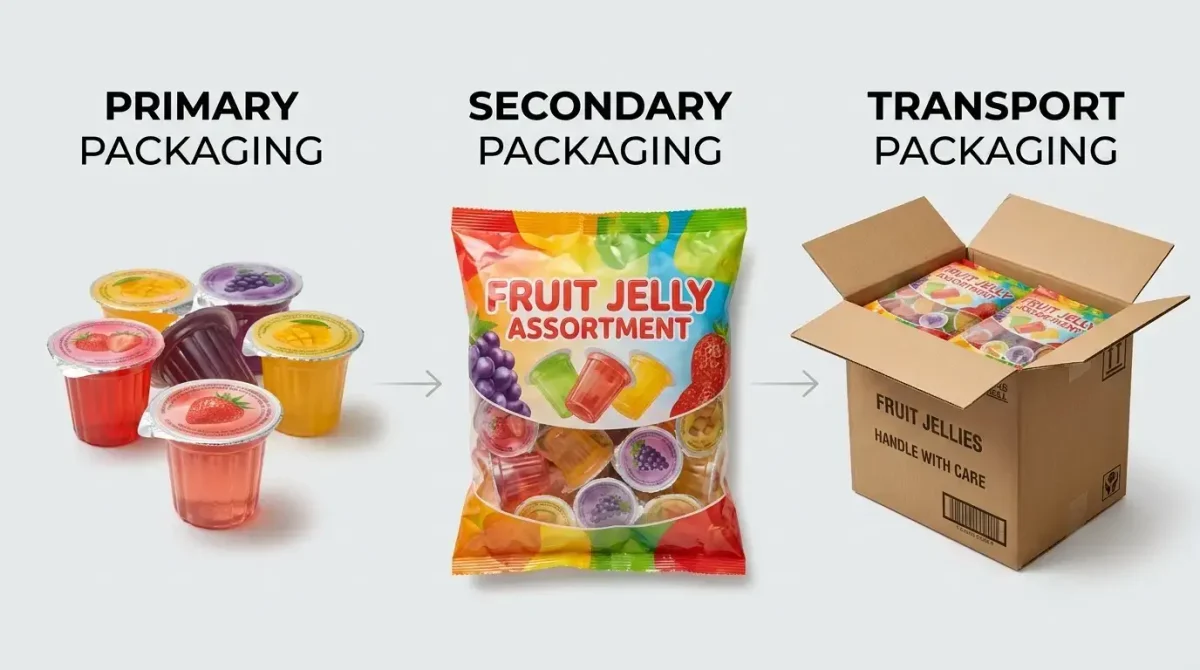
Unlike primary packaging, an outer pouch normally does not come into direct contact with the jelly. Its main purpose is to manage individually packaged products as a larger unit.
Reliable primary packaging begins with a compatible cup and film d'étanchéité pour gobelets, regardless of whether additional secondary packaging for jelly cups is used. An outer pouch cannot compensate for defective cup seals or insufficient primary packaging performance.
When Is an Outer Packaging Pouch Necessary for Jelly Cups?
Creating Retail Multipacks and Assorted Flavor Packs
An outer packaging pouch for jelly cups is particularly useful when brands want to sell multiple individually sealed cups as one retail unit.
From a product bundling perspective, combining individual products allows brands to develop different retail offerings without necessarily changing the primary packaging. The same jelly cup can be included in small trial packs, assorted flavor combinations, promotional bundles, or family-size packs.
Jelly manufacturers can package 15-gram jelly cups in bags containing 5, 20, 40, or 100 individual cups, showing how one primary product can support multiple sales configurations.
Providing Additional Branding and Label Space
Small jelly cup lids offer limited printing space. A printed outer pouch provides a larger surface for communicating brand identity, flavor combinations, product quantity, and other consumer information.
However, brands must verify which labeling information needs to remain on individual cups, particularly when they may be sold separately.
Improving Product Grouping and Handling
An outer pouch keeps small cups together, simplifying the handling of predetermined quantities during packing, distribution, and retail replenishment.
It may also reduce direct exposure to dust and surface abrasion. However, flexible pouches provide limited resistance to compression and should not replace suitable transport cartons.
For brands developing multiple product formats, understanding how jelly brands choose packaging by consumer use scenario can help determine whether jelly cup multipack packaging fits the intended retail experience.
When Can an Outer Packaging Pouch Be Skipped?
An additional pouch may be unnecessary when the existing packaging system already meets the product’s commercial and distribution requirements.
| Application | Why an Outer Pouch May Be Unnecessary |
|---|---|
| Individually sold jelly cups | Each cup already forms a complete retail unit |
| Foodservice distribution | Suitable shipping cartons may meet handling requirements |
| Retail carton packs | The carton already groups and presents the cups |
| Plastic jar multipacks | The jar performs the grouping and storage functions |
| Bulk wholesale distribution | Consumer-facing secondary packaging may not be needed |
A cost-benefit analysis helps manufacturers evaluate whether additional secondary packaging for jelly cups is commercially justified.
The cost of the outer pouch includes more than packaging material. Counting, loading, sealing, equipment operation, inventory, and logistics also need consideration.
In the business world, packaging features should reflect actual protection, distribution, and retail requirements.
If the outer pouch duplicates functions already performed by another packaging component, eliminating it may be the more economical choice.
Outer Pouches vs. Other Secondary Packaging Options
Flexible pouches are not the only option for jelly cup multipack packaging. Manufacturers should compare alternatives according to the required pack configuration, presentation, protection, and packing process.
| Packaging Format | Main Advantage | Main Limitation | Application type |
|---|---|---|---|
| Flexible outer pouch | Flexible pack configuration and printable surface | Limited compression resistance | Retail multipacks |
| Paperboard carton | Organized presentation and structural support | Requires suitable dimensions and packing arrangements | Fixed-count retail packs |
| Plastic jar | Rigid container and repeated opening | Container volume may affect storage and freight costs | Family-size packs |
| Direct case packing | Avoids an additional retail packaging layer | Limited consumer-facing presentation | Bulk wholesale and foodservice |
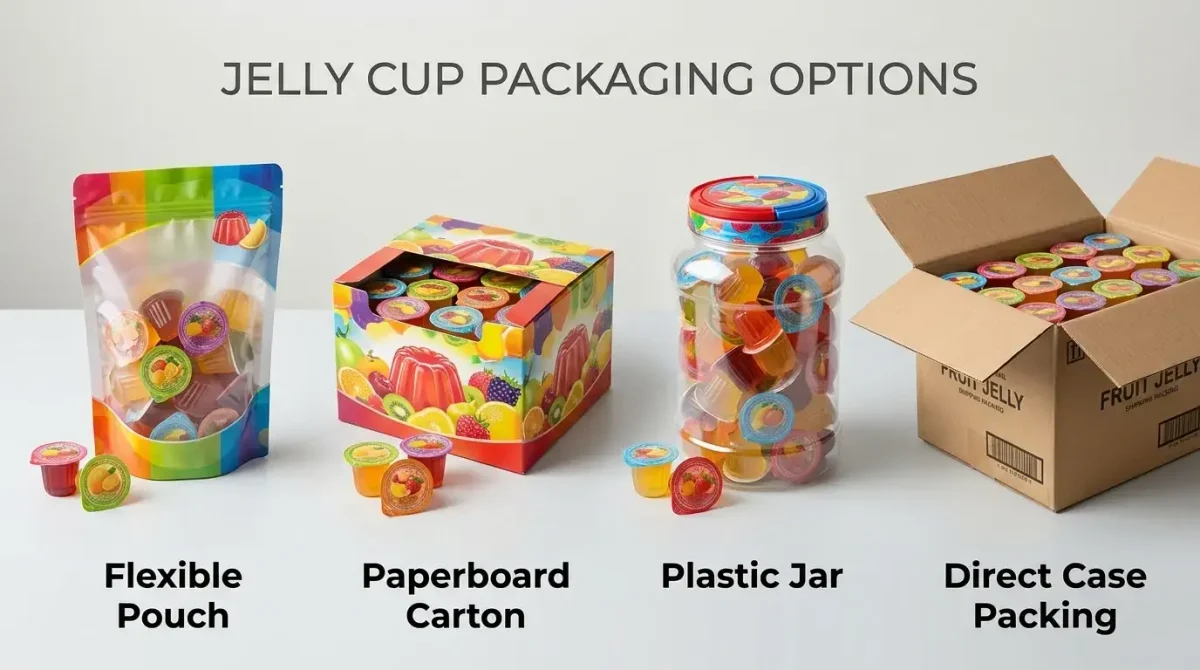
The best option depends on the total packaging system rather than the price of an individual packaging component.
Key Factors When Designing an Outer Pouch for Jelly Cups
Unlike pouches filled directly with food, a jelly cup outer pouch must accommodate multiple rigid or semi-rigid containers. The external dimensions and arrangement of the cups are therefore essential design inputs.
| Design Factor | What to Evaluate |
|---|---|
| Cup dimensions | Rim diameter, cup height, and overall shape |
| Pack count | Number of cups and intended flavor combinations |
| Cup arrangement | Orientation, loading space, and internal movement |
| Pouch strength | Gross pack weight, puncture resistance, and seal performance |
| Retail presentation | Printed graphics, transparent areas, and display method |
| Packing compatibility | Manual or automated loading, counting, and sealing |
Particular attention should be paid to cup rims. Repeated contact between rigid cup edges and flexible packaging may increase localized stress and abrasion.
When developing a custom jelly packaging pouch, test the proposed design using actual filled cups. The pouch should accommodate the intended quantity without excessive tightness, while its material structure and seals should withstand the expected handling conditions.
Customize Your Jelly Cup Outer Packaging with GQ PACK
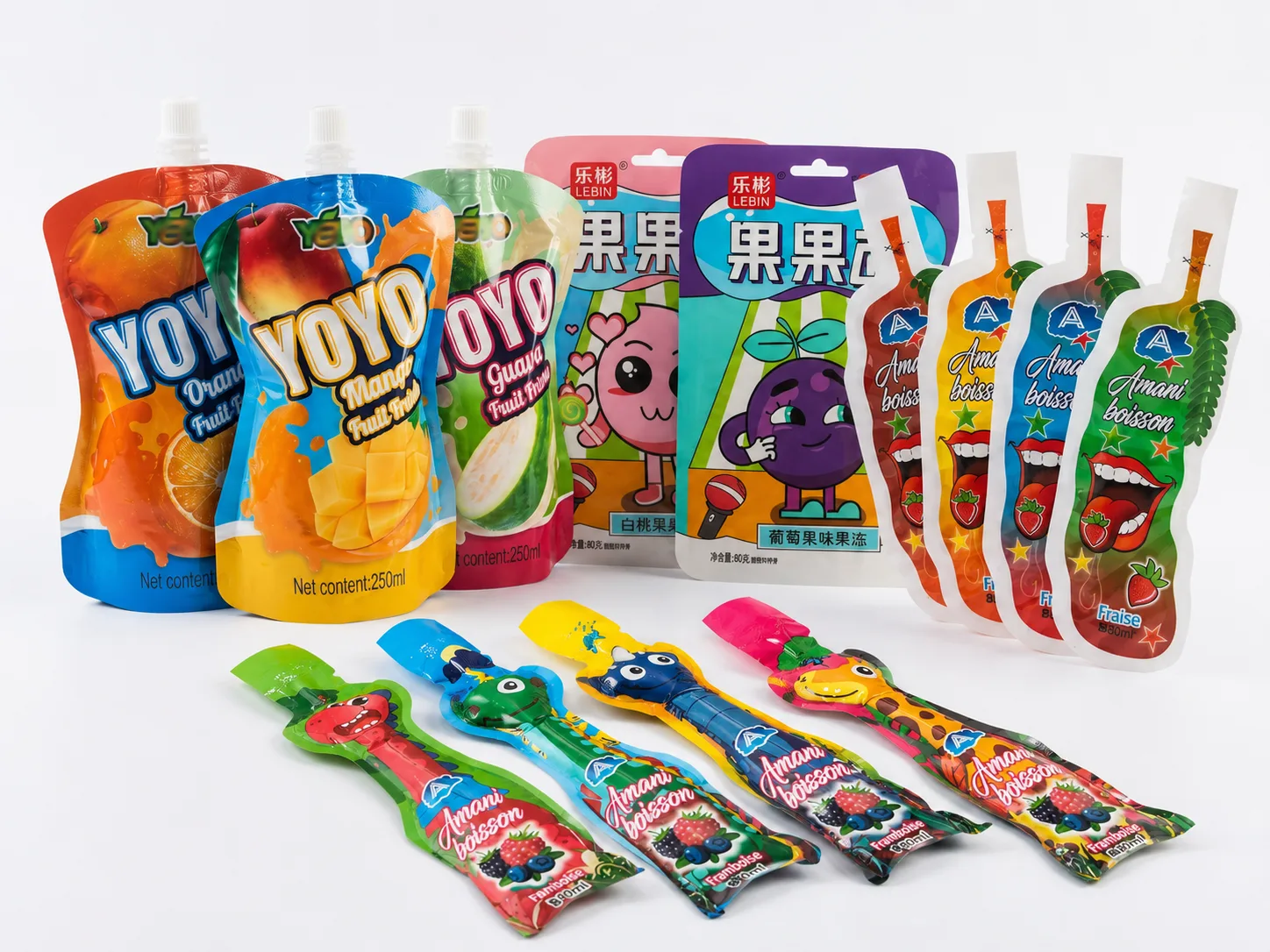
En tant que custom jelly packaging manufacturer, GQ PACK provides flexible outer packaging solutions for individually packaged jelly cups and jelly sticks, alongside customizable cup sealing films.
Our customization services cover packaging dimensions, material structures, printed designs, colors, and functional features according to project requirements.
Whether you are developing assorted flavor bundles, promotional multipacks, or family-size jelly products, GQ PACK can help evaluate suitable outer pouch configurations.
Share your cup dimensions, required pack count, gross package weight, retail channel, and packing equipment information with our team to discuss a customized outer packaging solution that balances product handling, retail presentation, and packaging costs.