RU
RU  EN
EN  DE
DE  FR
FR  AR
AR  ES
ES  JA
JA 
Coffee powder packaging must protect the product from moisture and oxygen while helping preserve its original flavor and aroma. Inadequate protection can contribute to clumping, oxidation, and declining product quality during storage and distribution.
В качестве coffee powder packaging manufacturer, GQ PACK points out that effective custom coffee powder packaging depends on three factors: selecting a suitable barrier structure, maintaining reliable seals, and controlling exposure during filling and storage. The right solution depends on whether the product is ground coffee or instant coffee powder, its intended shelf life, and the conditions it will encounter.
Why Does Coffee Powder Lose Moisture Stability and Flavor?
Moisture absorption and flavor deterioration are related but distinct problems. Packaging needs to address both rather than relying on a single barrier property.
How Moisture Affects Coffee Powder
Coffee powder can absorb moisture from the surrounding environment when the packaging allows water vapor to enter or when the product is exposed to humid air before sealing.
For ground coffee, moisture uptake can affect powder handling and contribute to clumping. For instant coffee, excessive moisture can also affect its physical properties and solubility.
A suitable moisture barrier coffee packaging structure helps slow moisture transmission. However, its effectiveness depends on the complete packaging construction, seal quality, and storage conditions.
How Oxygen Exposure Contributes to Flavor and Aroma Loss
Coffee contains volatile compounds that contribute to its characteristic aroma. Exposure to oxygen can promote oxidation and gradually change the product’s flavor profile.
Effective coffee aroma retention therefore requires more than controlling moisture. The package must also provide an appropriate oxygen barrier, while filling and storage practices should limit unnecessary exposure.
Для instant coffee powder packaging, moisture protection is particularly important because moisture uptake can compromise the product’s physical quality. Ground coffee also requires attention to oxidation and aroma preservation.
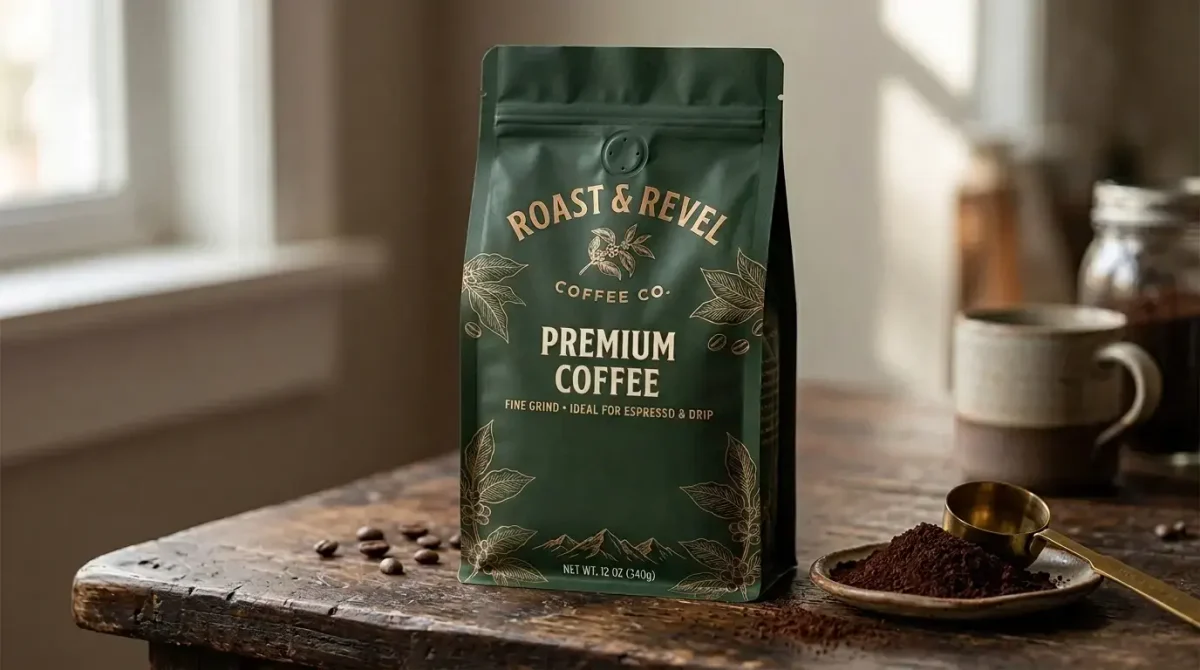
How to Choose Coffee Packaging Film for Moisture and Flavor Protection
The packaging film should provide a barrier level appropriate for the product and its intended storage period. Common approaches include aluminum-foil laminates, metallized-film laminates, and other high-barrier polymer structures.
Aluminum-Foil Laminates for Demanding Barrier Requirements
Aluminum-foil laminates are a potential choice when strong protection against moisture, oxygen, and light is required. They can be considered for coffee products with demanding preservation requirements.
However, foil is not automatically necessary for every application. The appropriate structure depends on the coffee formulation, required shelf life, distribution conditions, and overall packaging specifications.
Metallized Films and Other High-Barrier Structures
Metallized films and high-barrier polymer structures may provide suitable alternatives when their measured performance meets the product’s requirements.
The key distinction is that metallized film is not automatically equivalent to aluminum foil. Barrier performance varies with the specific material, layer construction, and finished package.
| Структура упаковки | Potential role | Important consideration |
|---|---|---|
| Aluminum-foil laminate | Applications requiring demanding barrier protection | Evaluate the complete laminate and finished seals |
| Metallized-film laminate | Applications where its barrier performance is sufficient | Performance varies by construction |
| Other high-barrier polymer structures | Applications with specific barrier and material requirements | Confirm suitability using relevant test data |
When evaluating high-barrier coffee packaging, compare the actual performance data rather than relying only on material names or general descriptions.
A suitable coffee packaging film should balance moisture protection, oxygen resistance, packaging requirements, and the intended application. There is no universal structure that is best for every coffee product.
Why Coffee Packaging Seal Integrity Matters
Even a high-barrier film cannot provide its intended protection if the finished package has defective seals.
How Seal Defects Can Undermine Barrier Protection
Incomplete seals, wrinkles crossing the sealing area, and coffee powder trapped between sealing surfaces can create weak points in the package. These defects may allow air and moisture to enter, undermining the barrier properties of the film.
This is why coffee packaging seal integrity matters alongside material selection. A suitable laminate must be converted into a finished package that consistently maintains its closure.
Why the Finished Package Must Be Evaluated
Material specifications describe the properties of the packaging material under stated test conditions. They do not, by themselves, establish that every finished bag will preserve coffee quality.
Evaluation should therefore consider both the film and the completed package, including seal consistency and possible damage during handling. For coffee powder, reliable closure is an essential part of the preservation system, not a secondary manufacturing detail.
How Do Filling and Storage Conditions Affect Coffee Freshness?
Packaging performance also depends on what happens before and after the bag is sealed.
During filling, prolonged exposure to humid air can introduce moisture before the package is closed. Powder trapped in the sealing area may also interfere with seal formation. Consistent filling and sealing conditions help reduce these risks.
After packaging, temperature, humidity, and storage duration can influence product stability. A package suitable for a short distribution cycle may not provide sufficient protection for a product expected to remain in storage for an extended period.
Coffee brands should therefore consider the intended distribution environment when selecting coffee powder packaging. Packaging can slow deterioration, but it cannot fully compensate for unsuitable storage or excessive exposure before sealing.
How Can Custom Coffee Powder Packaging Be Matched to the Product?
Different coffee products and packaging processes may require different combinations of material structure and package format. Ground coffee and instant coffee powder should therefore be evaluated according to their specific preservation needs.
At GQ PACK, we offer coffee packaging options including packaging film rolls, coffee packaging stand up pouch, coffee flat-bottom pouch, and coffee gusset pouch. Brands are welcome to explore our custom coffee packaging solutions or review our factory for further project communication.
For projects requiring custom coffee powder packaging, the important starting point is to identify the product type, desired shelf life, storage environment, and packaging process. These requirements help determine which structures should be considered and what performance data needs to be verified.
Заключение
Preventing moisture absorption and flavor loss requires more than choosing a material labeled high-barrier. Effective coffee powder packaging combines suitable moisture and oxygen resistance with reliable seals and appropriate filling and storage conditions. By evaluating material data alongside finished-package performance, coffee brands can make more informed packaging decisions without assuming that one structure fits every product.