RU
 EN
 DE
 FR
 AR
 ES
 JA

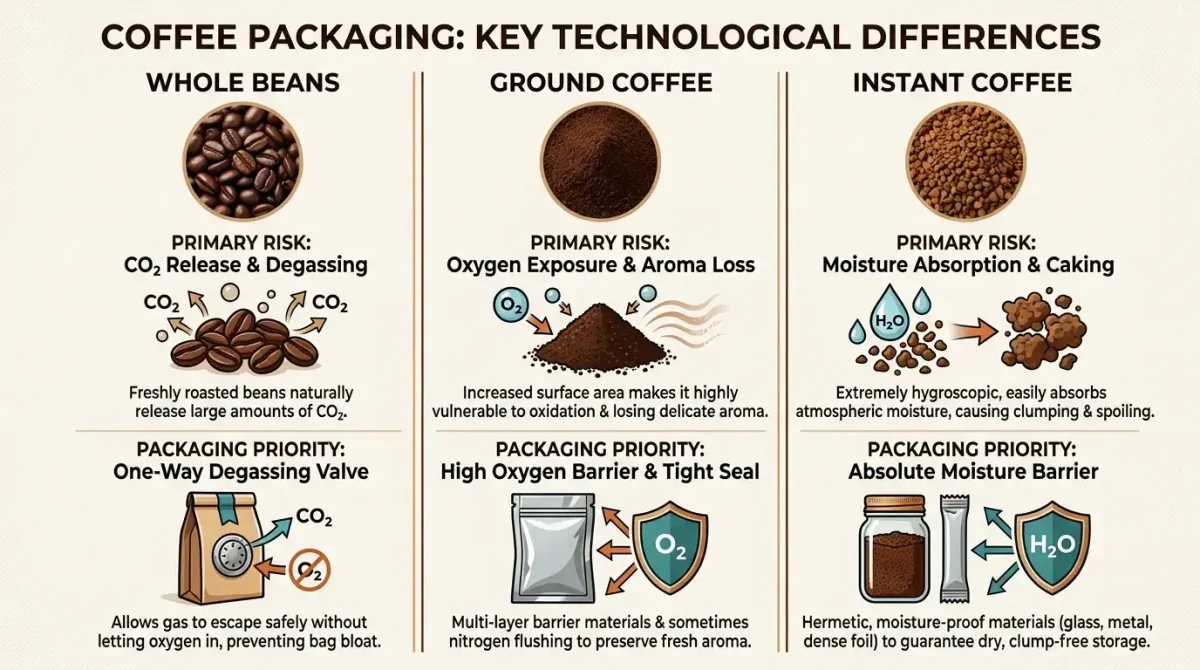
Choosing the right coffee bags involves more than selecting a pouch size or printing design. Whole coffee beans, ground coffee, and instant coffee have different physical properties, which affect how they respond to oxygen, moisture, and gas release during storage.
Whole roasted beans continue releasing carbon dioxide after roasting. Ground coffee has a larger exposed surface area and releases gas more quickly, while instant coffee is particularly sensitive to moisture absorption. These differences determine whether a package needs a degassing valve, a stronger moisture barrier, or a particular resealing feature.
For coffee brands, roasters, and food manufacturers, learning these requirements helps avoid packaging that compromises product quality, creates filling problems, or increases unnecessary costs.
Understand the Packaging Requirements of Different Coffee Products
Before comparing coffee packaging bags, identify the product being packed. The three main coffee forms have different preservation priorities.
Whole Coffee Beans: Continued CO₂ Release After Roasting
Roasted coffee beans retain carbon dioxide generated during roasting. After roasting, this gas gradually escapes from the beans, a process known as degassing.
If freshly roasted beans are packed in a completely sealed package without sufficient consideration of gas release, internal pressure may build up. This can cause the package to swell or place additional stress on its seals.
At the same time, roasted beans are vulnerable to oxygen, moisture, heat, and light. Exposure to these factors can accelerate quality deterioration and reduce the freshness of the coffee.
Therefore, coffee bean bags generally need two things: suitable barrier protection and a packaging design that accounts for residual gas release. A one-way degassing valve is often considered, especially when beans are packed relatively soon after roasting.
Ground Coffee: Faster Oxidation and Gas Release
Grinding breaks the beans into smaller particles and significantly increases the surface area exposed to the surrounding environment. Ground coffee therefore releases retained gas more quickly and is more exposed to oxygen.
This creates two important packaging considerations:
- Aroma and oxidation protection: The package needs an appropriate oxygen barrier to help preserve volatile aroma compounds and slow quality deterioration.
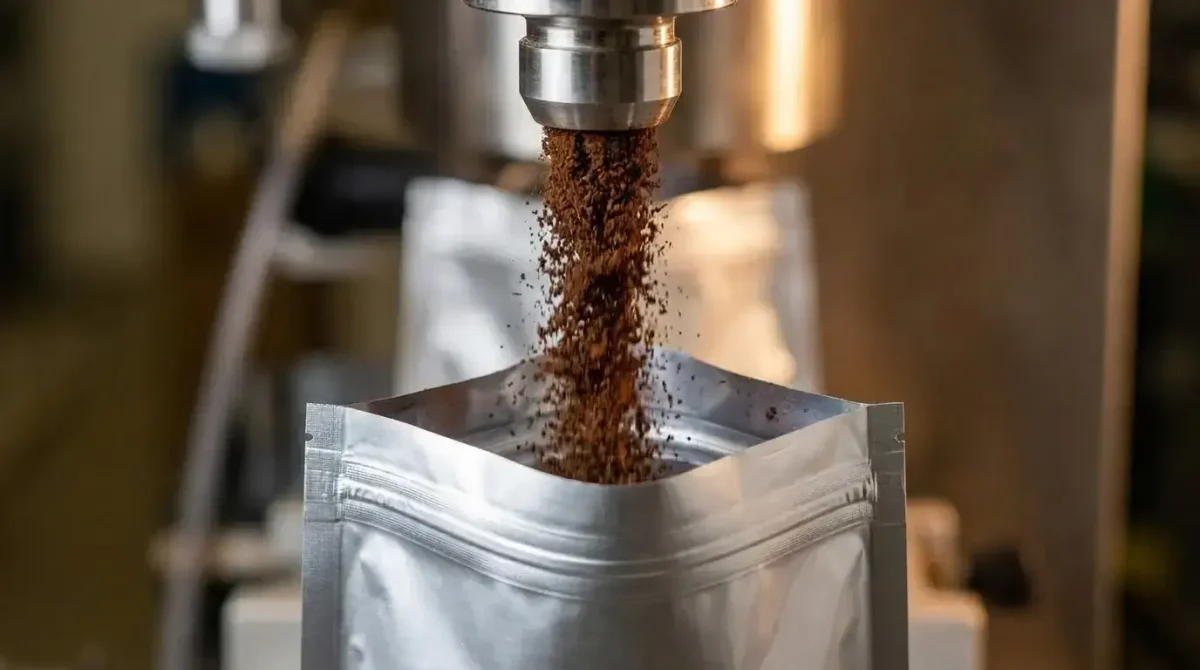
- Filling and sealing conditions: Fine coffee particles can contaminate the heat-sealing area. If powder remains between the sealing layers, the package may not seal properly.
Ground coffee packaging should therefore be evaluated according to grinding fineness, the time between grinding and packing, residual gas release, and the filling process.
A degassing valve may be useful in some applications, but it should not be treated as a universal requirement. The actual need depends on how much gas remains when the coffee is packed and how the product is processed.
Instant Coffee: Moisture Absorption and Caking
Instant coffee is different from roasted beans and ground coffee. It is a soluble coffee product that has already undergone extraction and drying. It does not have the same post-roasting degassing requirement as roasted coffee.
Its main packaging challenge is moisture absorption.
Instant coffee is hygroscopic, meaning it can absorb moisture from the surrounding air. Moisture uptake can cause particles to clump together, affect free-flowing properties, and reduce solubility.
For this reason, instant coffee packaging should prioritize moisture barrier performance and reliable seals. A degassing valve is generally unnecessary.
How to Choose Coffee Bags for Whole Coffee Beans
Whole bean packaging must protect roasted coffee while accommodating gas release. The right solution depends on roast date, packing schedule, distribution conditions, and retail format.
Select a Suitable Barrier Structure
A high-barrier coffee bag helps limit exposure to oxygen, moisture, and light. The required protection depends on the expected shelf life, storage environment, and distribution route.
For example, a brand selling freshly roasted specialty beans through retail channels may have different packaging requirements from a manufacturer supplying larger quantities to food-service customers.
Brands looking for high-barrier coffee bags should evaluate the required oxygen and moisture protection against the product’s shelf life and distribution conditions.
Do not assume that a thicker film automatically provides better protection. Material composition, layer structure, sealing quality, and package design all affect performance.
Decide Whether a Degassing Valve Is Necessary
A coffee degassing valve is a common feature to evaluate when designing coffee bags for freshly roasted whole beans. It allows gas inside the package to escape while helping prevent outside air from entering under normal operating conditions.
It is commonly considered for freshly roasted whole beans because they continue releasing CO₂ after packing.
However, valve selection should account for:
- The time between roasting and packaging.
- The amount of residual gas released after packing.
- The package size and filling weight.
- The expected storage and distribution conditions.
A valve does not replace barrier protection. The package still needs an appropriate structure to limit oxygen and moisture transmission.
Choose a Practical Bag Format
Stand-up pouches, flat-bottom pouches, and side-gusset bags are common options for whole beans.
- Stand-up pouches: Suitable for many retail applications, with a bottom gusset that allows the bag to stand on shelves.
- Flat-bottom pouches: Offer a stable base and multiple printable panels, making them suitable for premium retail presentation.
- Side-gusset bags: Often used for larger quantities and packaging formats that require a more traditional coffee-bag appearance.
A zipper can also help consumers reseal the package after opening. However, a zipper is a convenience feature rather than a substitute for the original hermetic seal.

How to Choose Coffee Bags for Ground Coffee
Ground coffee requires careful attention to both product protection and packaging-line performance.
Prioritize Oxygen and Aroma Protection
Because grinding increases the exposed surface area, ground coffee is generally more vulnerable to oxidation and aroma loss than whole beans.
The selected structure should provide an oxygen barrier appropriate to the product’s expected shelf life. Light and moisture protection should also be considered, especially for products distributed through multiple retail and wholesale channels.
The required barrier level should be confirmed against actual storage conditions and product stability requirements rather than selected by appearance alone.
Evaluate the Need for a Degassing Valve
Ground coffee can release gas more quickly than whole beans. However, this does not mean every ground coffee package needs a valve.
The decision depends on the coffee’s degassing stage at the time of filling. Coffee packed after sufficient degassing may have different requirements from coffee packed shortly after grinding.
The filling method also matters. If the package is filled with little residual gas, adding a valve may increase cost without providing meaningful value.
Check Seal Reliability During Filling
Fine particles can enter the sealing area during filling. This may interfere with the formation of a consistent seal and create potential leakage paths.
For ground coffee packaging, buyers should evaluate:
- Whether the filling process keeps the sealing area clean.
- Whether the selected film is compatible with the sealing equipment.
- Whether seal integrity is checked under representative production conditions.
- Whether the finished package can withstand handling and distribution.
A suitable packaging structure cannot compensate for poor filling or sealing control. Both the material and the packaging process need to be evaluated together.
How to Choose Coffee Bags for Instant Coffee
Instant coffee has different preservation requirements from roasted coffee. Its main concern is preventing moisture from entering the package during storage and after opening.
Prioritize Moisture Barrier Performance
Instant coffee can absorb moisture from humid air. If the packaging does not provide sufficient moisture protection, the product may develop lumps or become less free-flowing.
When selecting instant coffee packaging, evaluate:
- Water vapor barrier performance.
- Seal integrity and resistance to leakage.
- Storage and transportation humidity.
- The expected shelf life.
- Whether the package will be opened and resealed repeatedly.
The appropriate moisture barrier should be established according to the product’s stability requirements and actual distribution environment.
Which Packaging Formats Work for Instant Coffee?
Several formats can be used depending on the sales channel, serving size, and filling method.
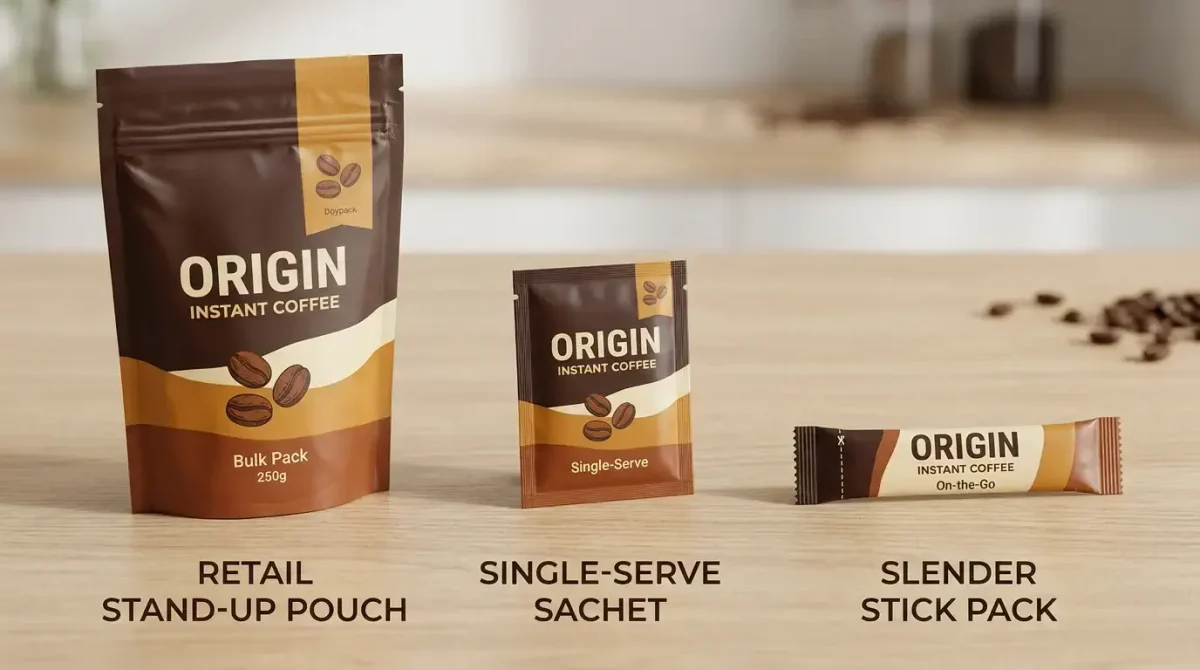
- Stand-up pouches: Suitable for retail packs and larger quantities of instant coffee. They can be combined with a zipper for repeated opening and closing.
- Individual sachets: Useful for single servings, hotel supplies, food-service applications, and promotional packs.
- Stick packs: A narrow format designed for portion-controlled products and convenient dispensing.
- Packaging film rolls: Suitable for automated packaging operations that form and seal individual sachets or other small packs.
For single-serve formats, packaging film rolls may be more appropriate than finished pouches. The film structure must match the product’s moisture protection requirements and the customer’s filling and sealing equipment.
Unlike roasted coffee, instant coffee generally does not require a degassing valve. Adding one without a clear technical reason may introduce unnecessary complexity.
Compare Coffee Bag Materials and Functional Features
The product type determines the main preservation challenge, while the material structure and functional features determine how the package addresses it.
Choosing Coffee Bag Materials for Barrier Protection
Different coffee bag materials can provide different levels of oxygen, moisture, and light protection. Common structures include:
- PET/AL/PE: A structure using an aluminum foil layer, commonly considered when strong light and barrier protection are required.
- PET/VMPET/PE: Uses metallized film as a barrier layer and can provide a balance of packaging appearance and protective performance.
- Kraft paper with barrier film: Combines a paper-like outer appearance with an inner packaging structure designed for product protection.
- Recyclable mono-material structures: May be considered when recyclability is a priority, but the barrier and sealing performance must be verified for the specific application.
There is no single best structure for every coffee product. The choice should consider the required oxygen and moisture barrier, light exposure, shelf life, filling conditions, and target market requirements.
For a more detailed comparison of paper-based and foil-based options, see kraft paper and foil coffee bags.
Functional Features That Affect Coffee Packaging Performance
Besides the film structure, additional features can improve usability and packaging performance.
| Характеристика | Whole Coffee Beans | Молотый кофе | Растворимый кофе |
|---|---|---|---|
| Односторонний клапан дегазации | Often considered for freshly roasted beans | Depends on residual gas and packing conditions | Generally unnecessary |
| Zipper | Useful for resealing retail packs | Useful for repeated opening | Useful for larger retail packs |
| Выемка для отрыва | Supports convenient opening | Supports convenient opening | Supports convenient opening |
| Oxygen barrier | Important for freshness protection | Particularly important due to increased surface area | Depends on product stability requirements |
| Moisture barrier | Important | Important | A primary packaging priority |
| Защита от света | Depends on storage and product requirements | Depends on storage and product requirements | Depends on product stability and package design |
The table provides general selection guidance, not a substitute for product-specific testing. Actual requirements depend on the coffee formulation, shelf life, and packaging conditions.
How to Select the Right Coffee Bag Format
The bag format affects shelf presentation, filling compatibility, storage, and shipping. It does not independently determine barrier performance; that depends primarily on the material structure and package seals.
| Bag Format | Типичные области применения | Main Considerations |
|---|---|---|
| Пакет-стоячка | Whole beans, ground coffee, instant coffee | Shelf visibility, resealable options, flexible sizing |
| Пакет с плоским дном | Premium whole beans and ground coffee | Stable base, multiple branding panels, structured appearance |
| Side-gusset bag | Whole beans and ground coffee | Suitable for larger packs and traditional coffee packaging |
| Packaging film roll | Instant coffee sachets, stick packs, and other automated formats | Must match filling equipment, sealing conditions, and required barrier performance |
The choice should also reflect the target sales channel. A premium coffee brand may prioritize shelf presentation, while a food manufacturer supplying single-serve instant coffee may prioritize portion control and automated packing efficiency.
Buyers comparing stand-up and flat-bottom coffee pouches should consider filling capacity, dimensions, shelf stability, and the required closure features rather than choosing by appearance alone.
Final Checklist Before Choosing Coffee Bags
Before confirming a packaging design or requesting a quotation, review the following points:
- Coffee type: Is the product whole bean, ground coffee, or instant coffee?
- Filling weight and dimensions: What is the target net weight, and what bag dimensions are required? Coffee density and particle size can affect filling volume.
- Preservation requirements: Does the product need stronger oxygen protection, moisture protection, light protection, or a combination?
- Degassing conditions: For roasted coffee, how long after roasting or grinding will the product be packed? Is a valve necessary?
- Bag format: Is the package intended for retail shelves, bulk supply, or single-serve applications?
- Functional features: Does the package need a zipper, tear notch, valve, or another accessory?
- Filling and sealing equipment: Are the film, bag dimensions, and sealing characteristics compatible with the production line?
- Distribution and shelf life: What storage conditions, transportation environment, and shelf-life targets must the package support?
- Printing and branding: What artwork, colors, surface finish, and product information need to appear on the package?
For brands and manufacturers developing a new coffee packaging project, working with a flexible packaging partner can help coordinate material selection, bag format, printing, and converting requirements. GQ PACK provides индивидуальные решения по упаковке кофе, including stand-up pouches, flat-bottom pouches, gusset bags, and packaging film rolls. Specific material structures, dimensions, and functional options should be confirmed against the product and filling requirements.
When developing custom coffee bags, buyers should confirm the material structure, dimensions, printing requirements, and functional features before production.
The right coffee bag is not simply the one with the most features. It is the package that provides the necessary protection, works reliably with the filling process, and fits the product’s sales and distribution needs.

Вопросы и ответы
1. Do All Coffee Bags Need a Degassing Valve?
No. A degassing valve is mainly considered for roasted coffee that continues releasing carbon dioxide after packing. It may be useful for whole beans and some ground coffee applications, depending on residual gas and packing time. Instant coffee generally does not require one.
2. Are Ground Coffee Bags Different from Whole Bean Coffee Bags?
They can be. Ground coffee has a larger exposed surface area and releases gas more quickly, making oxygen and aroma protection particularly important. Filling conditions also require attention because fine particles can contaminate the sealing area. Both formats need suitable barrier protection, but their valve requirements may differ.
3. What Is the Best Material for Instant Coffee Packaging?
There is no universal best material. Instant coffee packaging should prioritize moisture barrier performance and reliable sealing. The final structure depends on the product’s shelf life, storage conditions, package format, and filling equipment.
4. Can the Same Coffee Bag Material Be Used for Whole Beans and Ground Coffee?
Sometimes. A material structure may be suitable for both products if it meets their respective barrier and sealing requirements. However, the degassing conditions, filling process, and package features may need to differ.
5. Which Coffee Bag Format Is Suitable for Retail Packaging?
Stand-up pouches and flat-bottom pouches are common retail options because they can provide shelf visibility and space for branding. Side-gusset bags are also used for coffee, particularly in larger pack sizes. The final choice depends on filling weight, shelf presentation, closure requirements, and distribution needs.